During the Roman and Byzantine periods (3rd–7th centuries CE), the decoration of synagogue floors with elaborate mosaic pavements became one of the defining artistic traditions of the Land of Israel. These mosaics combined Jewish symbols—such as the menorah, shofar, and the Four Species—with geometric designs, human figures, animals, the zodiac, and scenes drawn from the Hebrew Bible.
These remarkable works of art reflect the exceptional skill of their craftsmen as well as the cultural influences of the surrounding Roman and Byzantine worlds. Beyond their artistic beauty, the mosaics served as expressions of communal identity, religious belief, and social status. Today, they are among the most important sources for understanding Jewish life in Late Antique Palestine.
Following their discovery, beginning in 2012 and continuing over several excavation seasons, the Huqoq mosaics attracted international attention and are now regarded as among the finest synagogue mosaics ever discovered in the Land of Israel.
As at many other ancient synagogues, archaeologists expected to uncover biblical scenes. Huqoq, however, proved to be exceptional. Alongside familiar biblical narratives, the mosaics revealed scenes unparalleled in ancient synagogue art, including images of winged cupids and elephants—subjects never mentioned in the Bible and previously unknown in synagogue mosaics from the region.
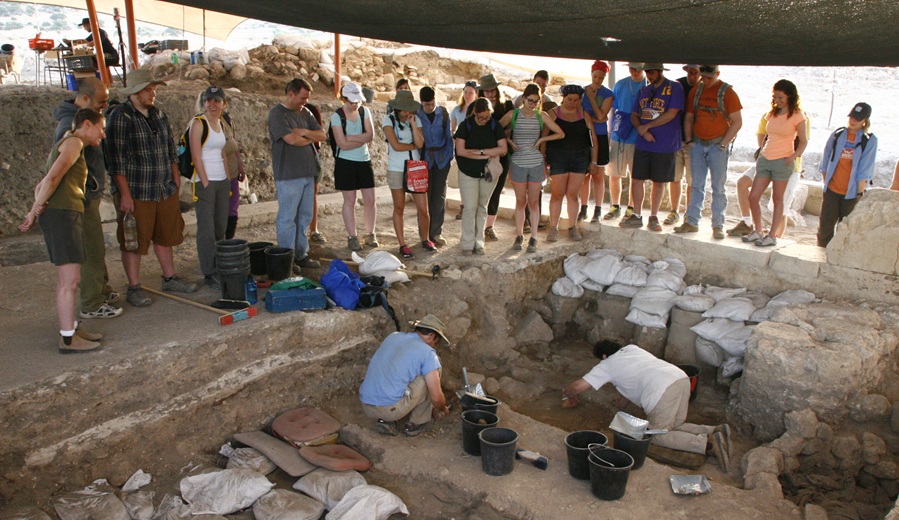
Uncovering the Samson Carrying the Gates of Gaza mosaic. Photo: Jim Haberman, Huqoq Excavation Project.
The discovery of the mosaics was only part of the story. Their documentation in the field represented a major methodological advance. Using digital photography, photogrammetry, and tablet-based recording systems, archaeologists replaced traditional paper drawings with digital documentation that could be shared instantly among specialists and integrated directly into the project's archaeological database.
The study and publication of the mosaics have been led by Dr. Karen Britt of Northwest Missouri State University and Dr. Ra'anan Boustan of Yale University.
The mosaic floors of the central hall (nave) and the side aisles are arranged in a series of pictorial panels. Here are some of their most remarkable scenes.
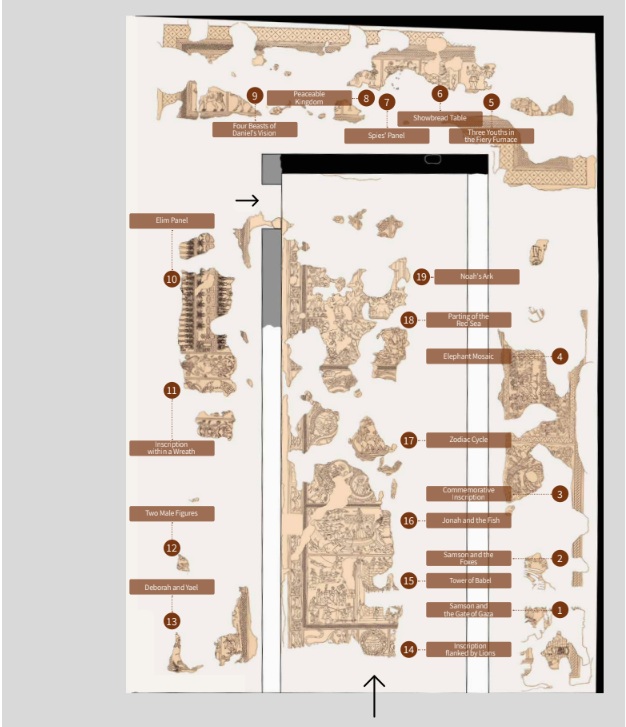
A mosaic map set against the layout plan of the synagogue, including the Elephant Mosaic, the Parting of the Red Sea Mosaic, the Samson Mosaic, the Noah’s Ark Mosaic, and others.
The Samson Mosaic: A Biblical Hero Dressed as a Roman Soldier
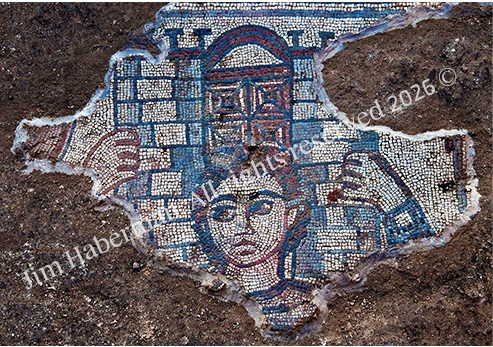
Photo: Jim Haberman, Huqoq Excavation Project
The Samson Mosaic is one of the most important discoveries from Huqoq—and the only original Huqoq mosaic currently on public display. It forms the centerpiece of the "
Secrets of Huqoq" exhibition at the Yigal Allon Centre on the shores of the Sea of Galilee, just a short distance from the landscapes where Jesus lived and where early Christianity first took shape.
Learn more about the exhibition.
At the center of the mosaic, Samson is depicted as a towering figure fleeing the ancient city of Gaza while carrying its massive city gate on his shoulders, as described in the Book of Judges:
"He took hold of the doors of the city gate and the two posts … and put them on his shoulders" (Judges 16:3).
Samson is intentionally shown much larger than the surrounding figures, emphasizing his extraordinary strength. He is portrayed with short reddish-brown hair and dressed in a belted tunic and flowing red cloak. Interestingly, his clothing closely resembles that worn by soldiers during the Late Roman and Byzantine periods, presenting the biblical hero in the visual language of the artists' own time.
Just north of this scene is another scene from Samson's life illustrating the story of Samson and the Foxes (Judges 15:4–5). The surviving section preserves part of Samson's torso and thighs together with portions of two pairs of foxes. To his left, the foxes are shown with their tails tied together by burning torches, just as described in the biblical account, each pair running in opposite directions. A third mosaic panel discovered nearby depicts Samson striking down the Philistines with the jawbone of a donkey (Judges 15:15–16).
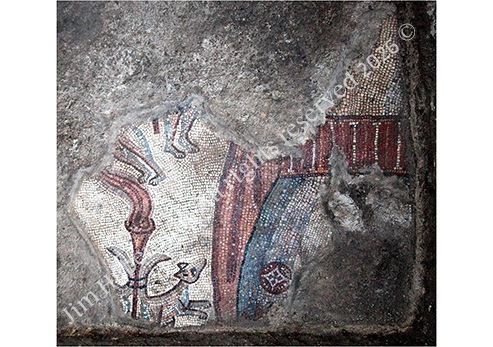
Photo: Jim Haberman, Huqoq Excavation Project
Scholars have suggested that the Samson mosaics conveyed an apocalyptic or messianic message. By depicting biblical narratives of divine deliverance, the community may have expressed its hope for future redemption. Some researchers have proposed that Samson was understood as a popular prototype of the coming Messiah—a heroic figure through whom God would ultimately bring salvation. Whether or not this interpretation is correct, Samson clearly served as a powerful symbol of communal identity, faith, and resilience.
Following the completion of conservation and site development at Huqoq, the Samson and the Gates of Gaza mosaic will return to its original location in the ancient synagogue.
The Commemoration Mosaic: An Inscription Preserved in Part
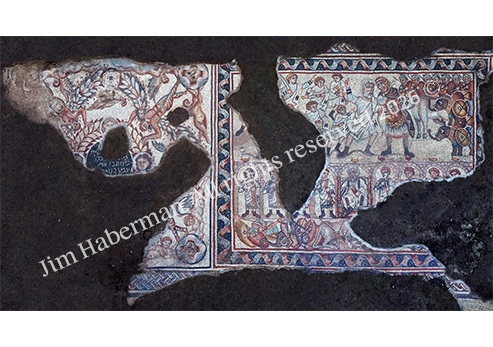 Photo: Jim Haberman, Huqoq Excavation Project
North of the Samson and the Foxes mosaic, archaeologists uncovered a square mosaic panel centered on a medallion containing an inscription in Hebrew or Aramaic. The composition was carefully designed to draw the viewer's eye directly toward the inscription, emphasizing its central importance within the decorative program.
The inscription is framed by a laurel wreath surrounded by circular medallions containing human heads—two female figures and one male figure above the central medallion—all facing toward the inscription. Scholars suggest that a fourth medallion, probably depicting another male head, originally appeared below the central panel. At each of the four corners of the mosaic stand muscular male figures holding up the wreath. They wear close-fitting trousers and boots, their bare chests prominently displayed, with raised arms supporting the garland. Each figure stands upon a sphere decorated with a human face or theatrical mask, while the spheres themselves are carried by nude winged figures.
What did the partially preserved inscription originally say? Although it cannot be reconstructed with certainty, scholars believe it may have commemorated the construction of the synagogue and included a blessing for those who faithfully observed the commandments, or perhaps for the individuals who contributed to the building of the synagogue.
Equally fascinating is the rich decorative world surrounding the inscription. Laurel wreaths, supporting figures, portrait medallions, theatrical masks, and winged cupids all derive from the artistic vocabulary of the classical Greco-Roman world. Their prominent place within the synagogue's decoration offers a vivid reminder of the cultural diversity and artistic sophistication of the Jewish community that flourished in the Galilee some 1,600 years ago.
The Elephant Mosaic: History or Creative Imagination?
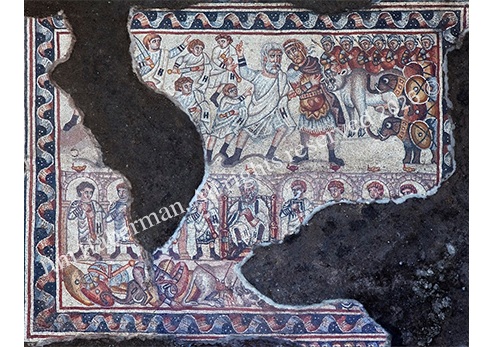 Photo: Jim Haberman, Huqoq Excavation Project
North of the Dedicatory Mosaic lies one of Huqoq's most extraordinary discoveries—the Elephant Mosaic. This remarkable panel depicts a dramatic military scene featuring war elephants, soldiers, and prominent leaders.
The composition is arranged in three horizontal registers that build toward the uppermost scene, where two large central figures appear to meet. The lowest register seems to portray the aftermath of a battle, with fallen soldiers alongside a bull and a war elephant with its rider. The middle register depicts eight young men standing beneath arches, each holding a sheathed sword. At the center sits an older, more prominent figure holding a scroll and seated on an elaborate throne. The figures wear richly decorated tunics and cloaks adorned with the Greek letter Η (eta), an indication of their elevated status. Above each figure burns a lamp, while the central figure is distinguished by his white hair and commanding presence.
No comparable scene is known from any other ancient synagogue mosaic. Does it commemorate a historical event from the Hellenistic period? Does it depict an encounter between a foreign ruler and Jewish leaders during the Hasmonean era? Or could it represent the legendary meeting between Alexander the Great and the Jewish High Priest? Unlike most of the Huqoq mosaics, this panel does not illustrate an identifiable biblical narrative, and the identities of its figures, the meaning of the encounter, and the historical event it portrays remain the subject of scholarly debate.
Whatever its precise interpretation, the mosaic almost certainly refers to a real or imagined event set in the Classical or Hellenistic world, demonstrating the remarkable breadth of historical and literary traditions represented in the synagogue's decoration.
Noah's Ark: Bears, Camels, and Leopards on Their Way to the Ark
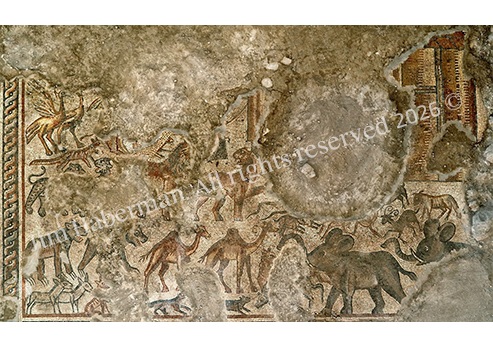 Photo: Jim Haberman, Huqoq Excavation Project
Moving from the side aisles into the synagogue's central nave, the northernmost mosaic panel depicts Noah's Ark together with pairs of animals, apparently before they entered the ark, as described in Genesis 6–7.
Among the animals that can be identified are lions, donkeys, elephants, bears, camels, leopards, snakes, sheep, ostriches, and foxes. Near the center of the composition survives the only preserved portion of the ark itself, represented as a wooden, box-like structure standing on legs. To its right is a partially preserved building with a tiled roof.
What was the relationship between this building and Noah's Ark? Unfortunately, we may never know. The section of the mosaic that originally connected the two elements was destroyed by a later pit, leaving this intriguing aspect of the composition open to interpretation.
Pharaoh's Army Drowning in the Red Sea: Why Are the Soldiers Dressed as Romans?
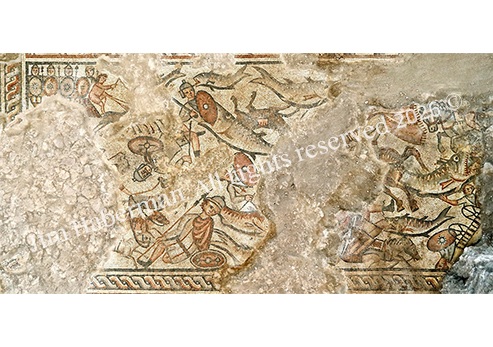
Photo: Jim Haberman, Huqoq Excavation Project
Immediately south of the Noah's Ark mosaic is one of the synagogue's most dramatic compositions, illustrating the Parting of the Red Sea and the destruction of Pharaoh's army (Exodus 14–15).
The mosaic vividly portrays Egyptian soldiers being overwhelmed by enormous fish as chariots and horses collapse into the sea around them. The composition conveys an overwhelming sense of chaos and destruction, with the giant fish emphasizing the irresistible power of the waters.
One particularly fascinating detail appears here and elsewhere in the Huqoq mosaics: Pharaoh's soldiers are dressed not as ancient Egyptians but in military attire typical of the Roman world. This reflects a common artistic convention of Late Antiquity, in which biblical figures and historical events were depicted using the clothing and visual language familiar to contemporary audiences. Rather than striving for historical accuracy, artists reimagined the biblical past through the lens of their own time.
Helios and the Zodiac: The Sun God at the Heart of the Synagogue
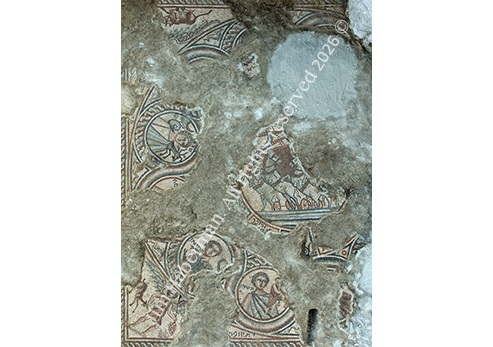 Photo: Jim Haberman, Huqoq Excavation Project
At the center of the synagogue's nave lies a large mosaic panel depicting Helios, the Greco-Roman sun god, surrounded by the zodiac wheel. This theme appears in the mosaic floors of eight other ancient synagogues in the Land of Israel, reflecting its popularity in Jewish art of Late Antiquity.
The Huqoq mosaic, however, is exceptional. In most synagogues, the zodiac is arranged in two concentric circles, with Helios at the center and the twelve zodiac signs set within twelve equal trapezoidal panels. At Huqoq, by contrast, the zodiac signs are enclosed within a series of interlocking circles—a highly unusual arrangement known elsewhere only from the ancient synagogue at Yafia, near Nazareth.
The central image of Helios has been damaged, making it impossible to determine whether it originally depicted the personified Greco-Roman sun god or the sun itself.
The surviving zodiac signs are represented by youthful male figures accompanied by the Hebrew names of the months and their corresponding zodiac symbols. For example, the month of Tevet is paired with Capricorn, shown as a goat with a fish's tail, while Tishrei is represented by a small figure holding a set of scales.
The four corners of the mosaic contain personifications of the seasons. Only Autumn survives intact. It is depicted not as a woman, as in all other known synagogue zodiac mosaics, but as a winged young man wearing a short tunic associated with craftsmen or agricultural workers. He carries a cluster of grapes and a staff in one hand and a pair of antlers in the other.
This unusual choice makes the Huqoq mosaic unique among known ancient synagogue floors, highlighting once again the creativity and originality of the community that commissioned it.
Jonah and the Fish: A Fish Swallows a Fish Swallows a Fish...
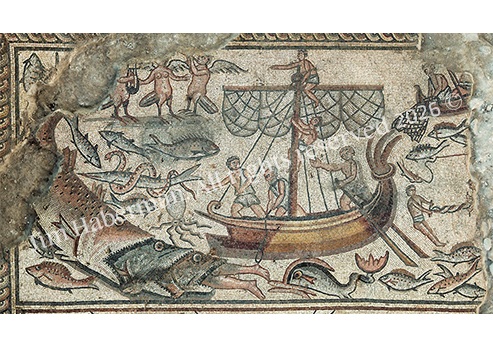
Photo: Jim Haberman, Huqoq Excavation Project
South of the zodiac mosaic is one of the synagogue's most celebrated scenes, illustrating the story of the Prophet Jonah being thrown into the sea by sailors and swallowed by a great fish (Jonah 1:12–15; 2:1). This is the earliest known depiction of the Jonah story in the decoration of an ancient synagogue.
The composition is filled with lively maritime imagery. It includes a fishing boat with a fisherman casting his net, two fishermen wringing water from a fishing net, and a large sailing vessel carrying five sailors. One sailor climbs the mast while another stands at its summit. At the center of the ship, a bearded figure—perhaps the captain—lowers a rope with a loop into the sea.
Below the vessel, Jonah's legs protrude from the mouth of a fish, which is itself being swallowed by a larger fish, which in turn is swallowed by an even larger one. This imaginative sequence creates one of the most memorable and visually striking scenes in the entire synagogue.
Equally intriguing are three hybrid creatures floating above the ship on a storm cloud. Each combines the head and bare torso of a woman with wings, the hindquarters of a bird, and bird's legs. Dancing while playing a lyre and a flute, they attract the attention of the sailor standing atop the mast, who points toward them. Their identity and significance remain uncertain.
The Tower of Babel: Pride, Chaos, and Divine Judgment
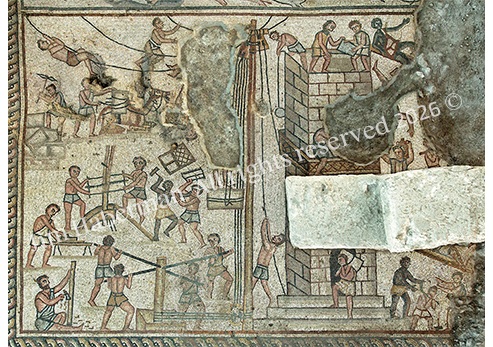
Photo: Jim Haberman, Huqoq Excavation Project
Immediately south of the Jonah mosaic is a panel illustrating the construction of the Tower of Babel (Genesis 11:1–9) and the divine punishment that followed humanity's act of pride.
The punishment is expressed through scenes of confusion and violence. Builders tumble from the tower while others attack one another, creating a vivid impression of disorder and chaos. The figures differ noticeably in appearance, perhaps representing the diversity of peoples whose languages were confused.
The tower itself is shown as a square structure surrounded by the tools and equipment of construction, including building stones, sawing implements, and rope-and-pulley systems. Together, these details transform the biblical narrative into a dynamic depiction of human ambition brought to ruin.
Elim: A Flourishing Oasis in the Wilderness
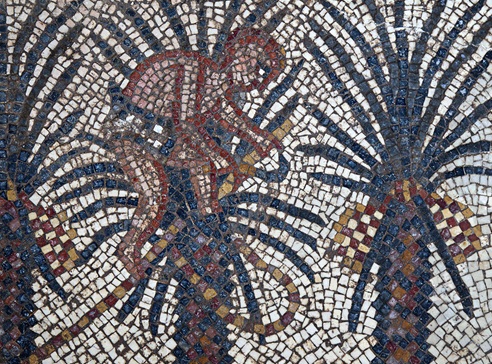
Photo: Jim Haberman, Huqoq Excavation Project
Elim was the Israelites' second encampment after crossing the Red Sea, described in Exodus 15:22–27 as an oasis with twelve springs and seventy date palms. Discovered in 2019, the Huqoq mosaic provides the earliest known artistic representation of this rarely illustrated biblical episode.
As Prof. Jodi Magness noted when announcing the discovery, "We have uncovered the first depiction of Elim in ancient Jewish art."
The mosaic portrays labourers harvesting clusters of dates while wearing short working garments. They lower the fruit along ropes to other workers waiting below. The central register alternates between wells and date palms, visually echoing the biblical description of twelve springs and seventy palm trees. On the left side of the panel, a man carrying a water jar enters a walled city through an arched gateway flanked by towers.
The identification of the scene as Elim is confirmed by a Hebrew inscription above the gate reading, "And they came to Elim" (Exodus 15:27).
Together with the synagogue's other extraordinary mosaics, this scene demonstrates both the richness of biblical imagination and the remarkable originality of the Huqoq artistic program.
The Vision of the Four Beasts: Daniel's Prophetic Dream
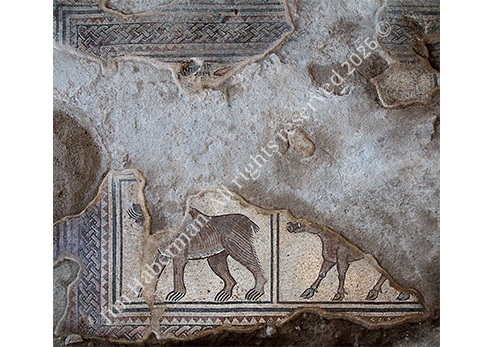
Photo: Jim Haberman, Huqoq Excavation Project
In the first year of the reign of Belshazzar, king of Babylon, the prophet Daniel experienced the famous vision of the Four Beasts (Daniel 7). This extraordinary prophecy is represented in another remarkable mosaic discovered in the synagogue's northern aisle.
The mosaic depicts the four symbolic creatures described in the biblical vision, each representing one of the kingdoms that, according to Daniel, would rule the earth before the end of days. The identification of the scene is confirmed by a fragmentary Aramaic inscription referring to the first beast—the lion with eagle's wings. Although the lion itself and most of the third beast have not survived, the second beast, a bear holding three ribs in its mouth, is well preserved, as are substantial portions of the terrifying fourth beast with its iron teeth.
This mosaic invites reflection on what Daniel's prophetic vision may have meant to the Jewish community of Huqoq. It suggests that hopes for the coming redemption and the end of history occupied an important place in the religious imagination of the congregation.
Deborah and Jael: The Defeat of Sisera
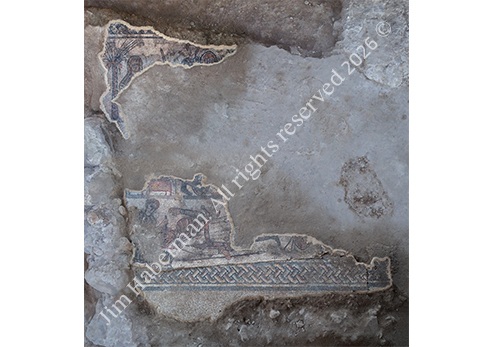
Photo: Jim Haberman, Huqoq Excavation Project
This mosaic illustrates the events of Judges 4. In the upper register, the military commander Barak, armed with a sword and shield, stands before the prophet Deborah, who is seated beneath a palm tree. As described in the biblical account, Deborah calls Barak to battle against Sisera, and together they lead Israel to victory.
Sisera escapes on foot, however, and seeks refuge in the tent of Jael, the wife of Heber the Kenite. Part of this episode survives in the partially preserved middle register. Instead of protecting him, Jael waits until Sisera falls asleep before driving a tent peg through his temple.
The lowest register depicts the dramatic climax of the story. Jael stands holding the tent peg and hammer while Sisera, portrayed as a giant figure, lies dead on the ground with his weapons scattered around him.
Located at the southern end of the synagogue's western aisle, the mosaic survives in two substantial sections, allowing scholars to reconstruct both the sequence of events and the central themes of the composition. It also raises fascinating questions: Which biblical and post-biblical traditions inspired its imagery? What might it reveal about gender in Jewish society during Late Antiquity? And why did this story hold particular significance for a Jewish community in Byzantine Galilee?
A Child Shall Lead Them: Isaiah's Vision of Peace
This mosaic depicts a young boy leading a wild animal—probably a wolf—by a leash. A Hebrew inscription between the boy and the animal identifies the scene as part of the prophet Isaiah's vision of the Messianic Age. The inscription quotes the final words of Isaiah 11:6: "And a little child shall lead them."
The full verse describes an ideal future in which animals that are natural enemies live together in harmony: "The wolf shall dwell with the lamb, and the leopard shall lie down with the young goat… and a little child shall lead them."
The boy wears a long-sleeved white tunic decorated with ornamental bands and short black boots. He looks back toward the leashed animal behind him. Above his head survives a small fragment of a black-and-red object whose identity remains uncertain. The interrupted border of the panel suggests that another wild animal may originally have appeared above it, also led by the same leash. If so, the composition would have illustrated more than one of the peaceful pairings envisioned by Isaiah.
The Spies' Cluster of Grapes: A Biblical Symbol of Abundance
A mosaic panel in the center of the upper row of the northern aisle depicts two men carrying an enormous cluster of grapes suspended from a pole across their shoulders. A Hebrew inscription reading "They carried it on a pole between two of them" identifies the scene as the return of the spies from the Valley of Eshcol (Numbers 13).
The mosaic illustrates one of the best-known symbols associated with the story of the spies: the enormous cluster of grapes brought back from the Promised Land as evidence of its extraordinary fertility and abundance. The exaggerated size of the grapes emphasizes the richness of the land that so impressed the Israelite scouts.
The Table of the Showbread: A Glimpse into the Jerusalem Temple
The Table of the Showbread was one of the sacred furnishings of the Tabernacle and later of the Jerusalem Temple. Each Sabbath, the priests replaced the loaves that had rested upon it with freshly baked bread.
This partially preserved mosaic panel, located in the eastern part of the synagogue, depicts the Table of the Showbread. A Hebrew inscription confirms its identification, while nearby ritual vessels associated with Temple worship are also represented.
Although the Table of the Showbread appears frequently in the mosaics of ancient Jewish and Samaritan synagogues, its setting at Huqoq is distinctive. Elsewhere, it normally forms part of a broader composition that includes the façade of the Temple, additional sacred vessels, altars, animal offerings, grain, oil, wine, and priestly figures. At Huqoq, however, the Table of the Showbread stands alone as the only preserved cultic image within the northern aisle, whose decorative program is otherwise devoted almost entirely to biblical narratives rather than Temple ritual.
This unusual placement underscores the originality of the Huqoq synagogue's artistic program and the diversity of ideas it sought to express.
The Three Youths in the Fiery Furnace: Defying Nebuchadnezzar
Like the four mosaic panels at the western end of the northern aisle, the four panels at its eastern end form a single narrative composition illustrating another episode from the Book of Daniel.
The surviving mosaic depicts two standing figures, while traces of a third figure remain to the right of the central figure. All three raise the index finger of their right hand toward heaven. Their number, Persian-style dress, and gestures identify them as Hananiah, Mishael, and Azariah—Daniel's three companions.
According to the biblical account (Daniel 3), the three young men refused King Nebuchadnezzar's command to bow before a colossal golden statue. As punishment, they were thrown into a blazing furnace, yet they emerged unharmed through divine intervention. The Huqoq mosaic captures this powerful story of faith, courage, and steadfast devotion to God in the face of persecution.
Conserving the Huqoq Mosaics: Stabilization and Protection
The Huqoq mosaics, together with other architectural elements of the synagogue, received preliminary conservation treatment during the excavations, supported by the Yad Hanadiv Foundation.
The mosaics were uncovered in varying states of preservation. Many were fragmentary, with missing sections and areas of subsidence caused by collapsed masonry or ancient stone robbing. In several locations, traces of burning were identified, although only the southeastern corner of the synagogue—where the Samson Carrying the Gates of Gaza mosaic is located—showed continuous evidence of fire severe enough to cause substantial damage.
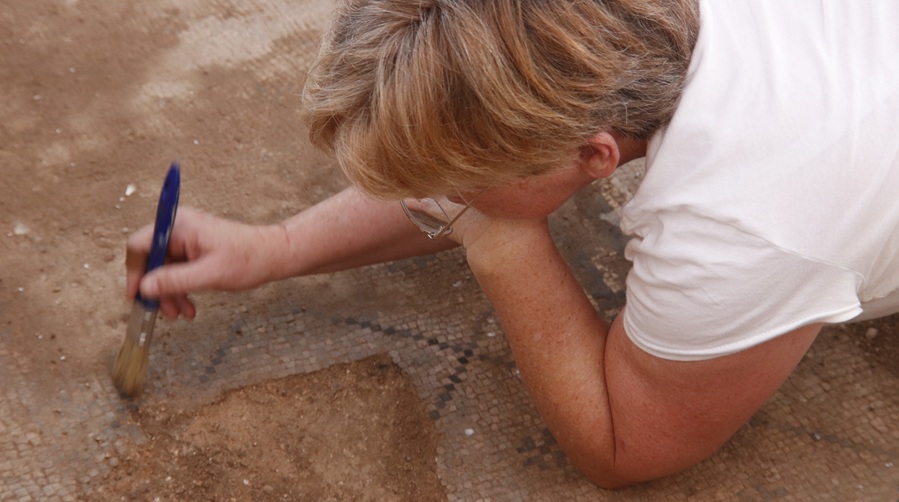
Conservation work on the synagogue mosaics. Photo: Jim Haberman, Huqoq Excavation Project
As each mosaic panel was uncovered, conservators immediately stabilized its edges, filled missing areas (lacunae) using traditional lime-based mortars containing sand and crushed ceramic, and carefully cleaned the surface. Salt deposits were removed through meticulous mechanical cleaning using fine conservation tools.
At the end of every excavation season, the mosaics were carefully reburied to ensure their long-term preservation. They were first covered with approximately 10 centimeters (4 inches) of sifted soil, followed by a permeable synthetic geotextile fabric that allowed drainage. Additional layers of soil, protective wooden boards to discourage unauthorized exposure, and more soil with large stones created a protective layer approximately one meter (3 feet) thick above the mosaics.
As part of the current Huqoq Heritage Project, the protected mosaics will be re-exposed and their condition thoroughly assessed in preparation for their future presentation to the public. For the first time since the building ceased to function as a synagogue, the entire structure will be fully exposed, enabling comprehensive documentation and high-resolution digital recording to support its long-term conservation and interpretation.