
In the summer of 2010, on a rocky hill in the Lower Galilee overlooking the blue waters of the Sea of Galilee, archaeologist Prof. Jodi Magness climbed to a site that, at first glance, appeared unremarkable. Here and there, ancient building stones protruded from the dry grass, the remains of later structures lay scattered across the slope, and wild mustard swayed in the warm breeze.
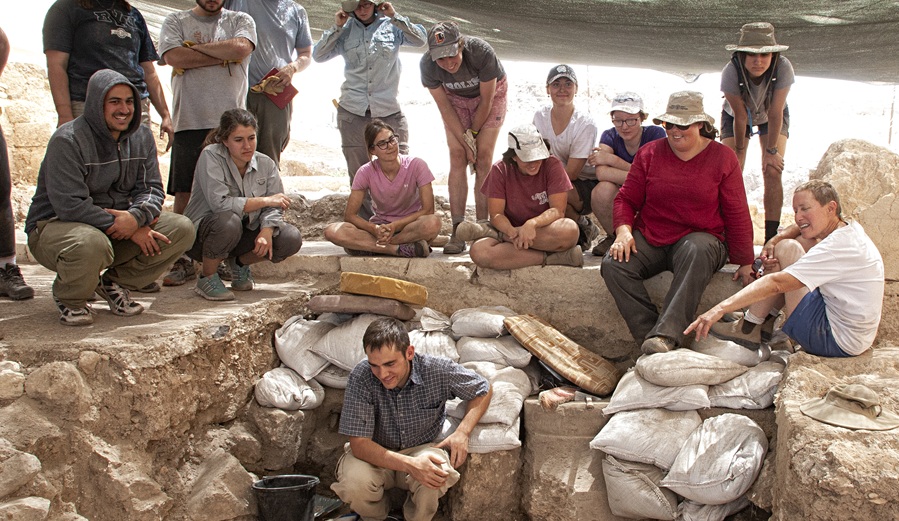
Prof. Jodi Magness (on the right) with members of the excavation team.
Photo: Jim Haberman, Huqoq Excavation Project.
It was hard to imagine that beneath the surface lay one of the most surprising and spectacular archaeological discoveries made in Israel in recent decades.
Prof. Magness, a scholar of Early Judaism at the University of North Carolina at Chapel Hill, had already directed archaeological excavations in Israel. But there was something about Huqoq—a Jewish village known from ancient sources that flourished during the Roman and Byzantine periods—that captured her imagination. She soon discovered that her instincts were well founded.
In fact, Prof. Magness came to Huqoq in search of an unexcavated Galilean-type synagogue, hoping to resolve a long-standing scholarly debate: Were these synagogues built in the third century CE or in the fifth? The best way to answer this question was to excavate a synagogue that had never before been explored, together with the village in which it stood. After all, every Jewish village of this period had a synagogue that served as an important religious, social, and communal center.
When excavations began the following summer (2011), the team carefully removed layers of soil and stone until a substantial masonry wall emerged nearly two metres below the surface. Its orientation, together with other architectural features—including a main entrance facing Jerusalem—led to an exciting conclusion: they had uncovered an ancient synagogue. As the excavation progressed, it became clear that the building had been constructed in the early fifth century CE.
Yet the greatest surprise still lay beneath the surface. In June 2012, the face of a woman, composed of thousands of tiny mosaic tesserae, gradually emerged from the earth. Even for experienced archaeologists, these are rare moments when time seems to stand still—a face hidden for nearly 1,600 years meets human eyes once again.
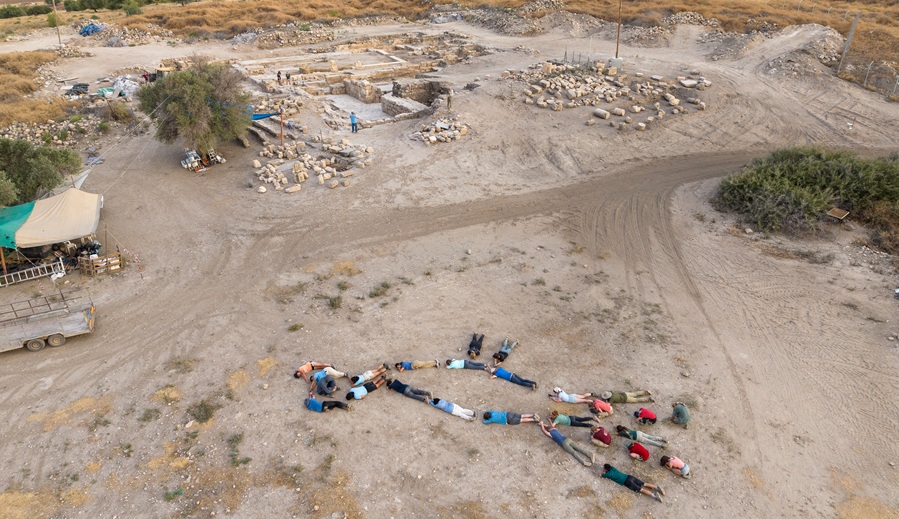
View towards the synagogue. Aerial image: Griffin Higher Photography
Year after year, more sections of the synagogue's magnificent mosaic floor were uncovered—biblical scenes, enigmatic figures, and narratives never before seen in the art of ancient synagogues. With each new discovery, it became increasingly clear that Huqoq was far more than another archaeological site. It offered a unique window into the world, beliefs, and aspirations of the Jewish communities of the Galilee some 1,600 years ago.
An Ideal Site for Archaeological Excavation
"The site's long history, the remains visible on the surface—including architectural elements characteristic of a synagogue—its accessibility, and the act that it had never previously been excavated made Huqoq an ideal site for archaeological investigation," wrote Jodi Magness in one of her many publications on the site.
Magness founded the Huqoq Excavation Project, an international consortium of universities that began excavating the site in the summer of 2011. Shua Kisilevitz served as Deputy Director during the project's first nine excavation seasons (2011–2019), followed by Dennis Mizzi, who served in that role from 2020 to 2023.
The project had three principal goals: to excavate the village synagogue; to investigate parts of the ancient village in order to understand the synagogue within its broader archaeological and social context; and to document and preserve the history of the former Arab village of Yaquq through archaeological excavation and archival research.
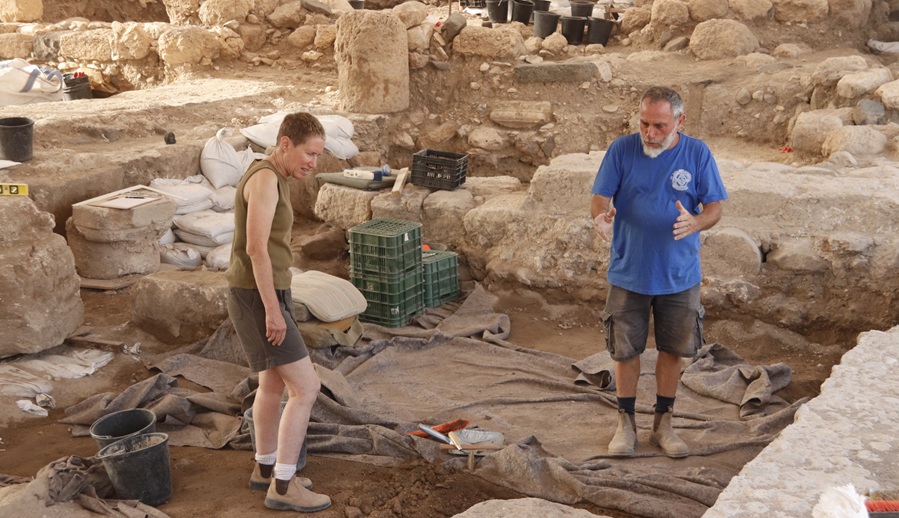
Expedition Administrator Miki Golan and Prof. Jodi Magness. Photo: Jim Haberman, Huqoq Excavation Project.
Excavations at the Site (Huqoq Excavation Project)
In the summer of 2011, following a preliminary survey carried out in collaboration with Dr. David Amit, the first systematic archaeological excavation at Huqoq began under the auspices of a joint North American university expedition directed by Prof. Jodi Magness of the University of North Carolina at Chapel Hill. Dr. Shua Kisilevitz of the Israel Antiquities Authority served as Assistant Director of the excavation.
Three principal excavation areas were established: Area 2000 ("The Village"), located on the eastern side of the hilltop; Area 3000 ("The Synagogue"), at the summit of the hill; and Area 4000 ("The Southern Mikveh"), on the southern slope. The excavations have shown that the site was occupied almost continuously from the Bronze Age through the modern period.
The table below summarizes the principal discoveries from each of the excavation areas.