Discovering the Hidden: Highlights of the Huqoq Archaeological Site

The Roman-Byzantine Synagogue and Its Mosaics

The crown jewel of the Huqoq Excavation Project, directed by Prof. Jodi Magness, is the discovery of a monumental synagogue dating to the Roman-Byzantine period, constructed around 400 CE. Yet the synagogue's greatest treasure lies beneath your feet: its spectacular mosaic floors. Richly decorated with biblical and extra-biblical scenes alongside depictions of everyday life, these mosaics offer an extraordinary window into the world of the Jewish community that flourished here some 1,600 years ago.

Centuries later, during the Middle Ages, the building was reused and expanded to create a second, larger synagogue, preserving the site's role as a center of Jewish communal life.

Located at the heart of the archaeological site, the synagogue crowns the summit of the hill, just a few meters south of a solitary palm tree that stands out prominently from nearby Highway 65 and serves as one of Huqoq's most recognizable landmarks.
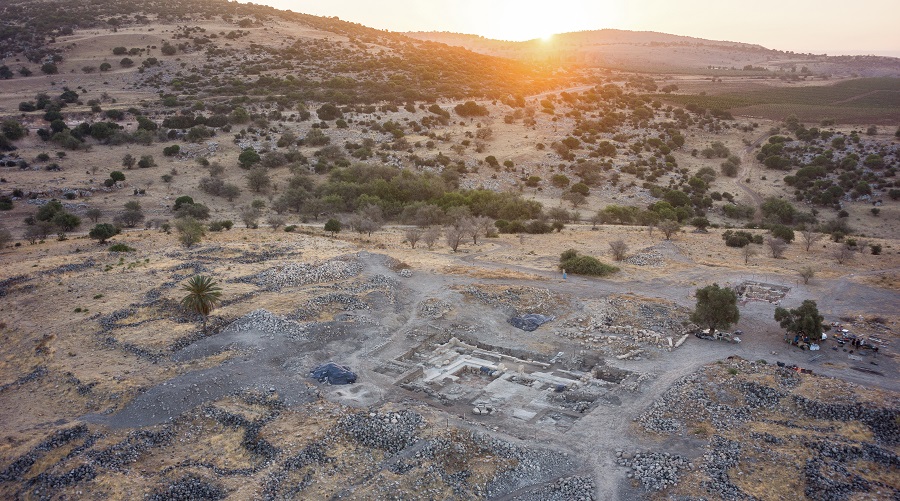
 
Sunrise over the Huqoq SynagogueSunrise over the Huqoq Synagogue. Aerial image: Griffin Higher Photography

The Ancient Village

In the summer of 2011, the first scientific excavations at Huqoq were launched by an international university expedition directed by Prof. Jodi Magness of the University of North Carolina at Chapel Hill. One of the project's principal goals was to uncover the ancient Jewish village and understand the setting of the synagogue that was expected to lie within it.

Excavations carried out over successive seasons revealed a settlement with an exceptionally long history, occupied intermittently from the Early Bronze Age until 1948. Jewish settlement at Huqoq began during the Late Hellenistic period and reached its height in the Roman and Byzantine periods.

During the Middle Ages, the site appears in pilgrims' accounts as the Muslim village of Yaquq. It continued to be known by this name throughout the Ottoman and British Mandate periods, when it was described as a rural agricultural village.

The ancient Jewish settlement covered approximately 30 dunams (about 7.5 acres) and was characterized by densely packed houses connected by narrow, winding streets. Remarkably, this pattern of construction continued into the medieval period, illustrating centuries of continuity. At the heart of the village stood the synagogue, serving as its religious and communal center.

Excavations have revealed many aspects of everyday life, including residential buildings, ritual baths (miqva'ot), water cisterns, ancient roads, quarries, agricultural terraces, and a variety of farming installations. Among the most unusual discoveries are facilities used to produce mustard oil, echoing ancient Jewish sources that associate Huqoq with mustard cultivation.
Beneath the ground, hidden chambers and burial caves provide further insights into the lives of the village's inhabitants, while Huqoq Spring, at the foot of the hill, supplied fresh water to generations of residents.

Parts of the village, including residential buildings and a ritual bath, were uncovered by the Huqoq Excavation Project. Other areas continue to be investigated by the Israel Antiquities Authority as part of the current heritage development project, steadily expanding our understanding of this remarkable community.
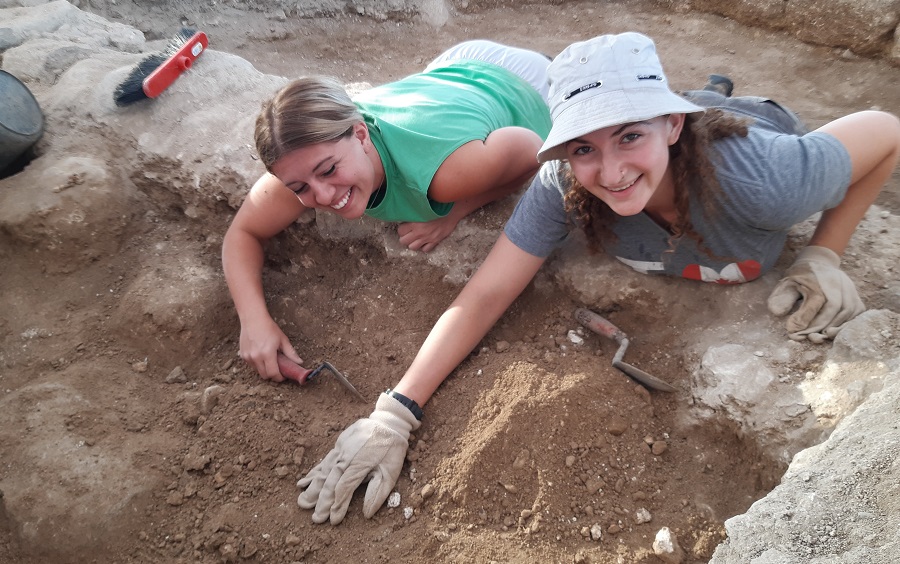
 
American students excavating at HuqoqAmerican students excavating at Huqoq. Photo: Shua Kisilevitz.

The Medieval Synagogue: A Rare Chapter in Jewish History

One of the most surprising discoveries at Huqoq was not the Byzantine synagogue itself, but the building constructed above it several centuries later.
During the 14th century CE, the earlier synagogue was extensively remodeled and enlarged. Its eastern and northern walls were incorporated into a new basilical building that extended farther to the west and south. Architectural elements from the Byzantine synagogue—including columns and finely dressed stonework—were carefully reused, while a new floor was laid over the earlier remains.

The later structure measured approximately 24 × 17 meters (79 × 56 ft), making it significantly larger than its Byzantine predecessor. Benches lined three sides of the hall, and the building's plan and architectural features strongly suggest that it also functioned as a synagogue.

If this interpretation is correct, Huqoq preserves the only known synagogue from the Mamluk period in the Land of Israel. This remarkable discovery demonstrates that Jewish communal life continued at the site long after the Byzantine period and provides an exceptionally rare glimpse into Jewish settlement in medieval Galilee.

In 2018, excavation in the area south of the main structure of the synagogue uncovered one of the site's most remarkable discoveries: a spectacular hoard of 364 gold and silver coins dating to the 14th and 15th centuries CE, offering a unique glimpse into life in medieval Palestine.

The coins were concealed inside two small, matching ceramic juglets, buried beside a collapsed wall near the medieval synagogue. Although archaeologists do not know who owned the treasure or why it was hidden there, it is clear that this was a considerable fortune concealed in the heart of a small village. The hoard included coins issued by both the Venetian Republic and the Mamluk Sultanate, reflecting the commercial connections that linked the Galilee with the wider Mediterranean world during the Late Middle Ages.

Equally fascinating are discoveries made beneath the village houses. Archaeologists uncovered additional caches of coins, together with personal belongings such as a bronze ring dating to the early 2nd century CE and an iron knife, possibly from the time of the Bar Kokhba Revolt. These modest objects tell stories every bit as compelling as the great treasure itself—of savings carefully hidden, treasured personal possessions, and perhaps even a weapon kept close at hand during uncertain times.
Every excavation season reveals new discoveries while raising new questions. The more Huqoq is uncovered, the richer and more complex the story of this remarkable village becomes.

The Hiding Systems: Underground Refuge Beneath the Village

One of the most exciting discoveries at Huqoq lies hidden beneath the ancient village itself. Concealed below the ground are three underground hiding systems, including one of the most extensive and sophisticated refuge complexes yet discovered in the Galilee.

During the Roman period, particularly around the time of the First Jewish Revolt (66–73 CE) and the Bar Kokhba Revolt (132–135 CE), Jewish communities throughout the Land of Israel carved elaborate underground hiding systems. These carefully engineered networks consisted of chambers, narrow tunnels, crawl spaces, concealed entrances, and interconnected shafts designed to provide refuge during times of danger. Their low, winding passages made it difficult for enemy soldiers to advance, while hidden chambers allowed families to shelter together with food, water, and essential supplies for extended periods.

To date, three hiding systems have been identified at Huqoq, making the site part of a network of more than eighty-five known hiding complexes in the Galilee. Two are located beneath the synagogue, where they are accessed through ancient water cisterns and predate the construction of the Byzantine building.

The third—and by far the largest and most sophisticated—extends beneath the northern slope of the hill. Its rediscovery began not with a formal archaeological excavation but with members of Kibbutz Huqoq, who first explored and partially excavated sections of the underground passages. The complex was subsequently mapped in 1982, and only in recent years has it been systematically excavated and documented, revealing its full extent and remarkable complexity.

Within these cramped, twisting passages, illuminated only by the flickering light of clay oil lamps, generations of villagers sought refuge during periods of insecurity. Originally carved in the Roman period, the hiding systems continued to be reused and adapted in later centuries, reflecting the long and sometimes turbulent history of the settlement.

Archaeological excavation has yielded small but evocative discoveries from within the hiding systems, including clay oil lamps, coins, a bronze ring dating to the early 2nd century CE, and an iron knife that may date to the time of the Bar Kokhba Revolt. These modest objects provide intimate glimpses into the lives of the people who once sheltered underground, carrying with them only the possessions they considered most essential.

Today, the Huqoq hiding systems are being investigated by the Israel Antiquities Authority in collaboration with Zefat Academic College under the direction of Uri Berger, Prof. Yinon Shavtiel, Tzviki Badihi, and Oren Zingboim. As research continues, these remarkable underground spaces are revealing new chapters in the story of Huqoq and the resilience of the community that lived here.

Huqoq Spring: The Lifeblood of the Village

Long before the synagogue was built and centuries before the village reached its height, Huqoq Spring was the reason people settled here in the first place.
In antiquity, a reliable spring was far more than a source of drinking water—it determined where villages were founded, where roads passed, and where agriculture could flourish. For generations, Huqoq Spring supplied the water needed for drinking, cooking, farming, livestock, and countless daily activities. In a Jewish village, it also sustained religious life by providing the continuous flow of water required for ritual baths (miqva'ot).

For nearly two thousand years, the spring served successive communities that made Huqoq their home. It supplied water to the Jewish village of the Roman and Byzantine periods and later to the Arab village of Yaquq during the Ottoman era. Located northwest of modern Kibbutz Huqoq, near Highway 65 and the National Water Carrier, the spring remains one of the defining features of the landscape.

During the British Mandate period, a substantial spring house was constructed over the source using large basalt stones. The structure enclosed an underground collecting pool reached by a flight of steps, while additional pools, channels, a sabil (public fountain), and watering troughs formed an integrated water system that distributed this precious resource throughout the village. Pilgrims visiting the nearby Tomb of Habakkuk and travelers journeying north from Tiberias also relied on the spring, making it an important stop along regional routes.

Today, the historic water system is the most complete surviving architectural remnant of the village of Yaquq, abandoned in 1948. As such, it provides a rare opportunity to understand how a traditional Galilean village managed one of its most valuable natural resources.

Beyond its historical importance, the archaeological investigation of the spring has also advanced the study of historic rural water systems. Few spring complexes have been excavated as comprehensively as Huqoq, and the discoveries made here have contributed significantly to our understanding of how such systems were designed, constructed, maintained, and adapted over time.

The conservation and restoration of the spring house, carried out by the Israel Antiquities Authority with funding from KKL–JNF, followed the principle of minimal intervention. Rather than reconstructing missing elements without archaeological evidence, conservators focused on stabilizing the existing structure, preserving as much original material as possible, and ensuring its long-term survival. Modern additions were kept to an absolute minimum and introduced only where necessary for structural stability and visitor safety.

Today, Huqoq Spring continues to tell the story of the people who depended on it for centuries. Nestled among ancient jujube trees on the slopes of Mount Habakkuk, it preserves not only a historic water system but also the traditional Mediterranean cultural landscape in which the village developed.

The spring house before the conservation. Photos:

The spring house after the conservationThe spring house before and after conservation.
Photos: Einat Ambar-Armon, Israel Antiquities
Authority.