The initiative for the conference emerged during a condolence visit between Yarus, Yemanu’s sister and a graduate of the Hannaton Mechina, and Rabbi Yoav Ende, the executive director of the Hannaton Educational Center, located in Kibbutz Hannaton in the Lower Galilee.
In his address at the conference, Rabbi Yoav Ende, Executive Director of the Hannaton Educational Center, said:“We must not allow violence to enter our educational frameworks. Violence against women, violence in Arab society, violence in Judea and Samaria, violence in the name of family honor, youth violence — these are not separate phenomena. This is a broad and deeply frightening phenomenon.
 Photography: Nachshon Phillipson
“The world of young people is shaped by the reality around them, and the direction is alarming. We must wake up, and we in the world of mechinot [pre-military academies] intend to do everything in our power to ensure this issue stands at the forefront of educational efforts in Israel.
“We call on the leadership to take responsibility, together with civil society, and act to stop this wave of violence before it becomes a reality we can no longer ignore.”
The conference was attended by members of Yemanu Zelka’s family, heads of pre-military academies, and 400 young attendees of mechinot from around Israel. The attendants took part in discussion circles about the social reality in Israel and ways to bring about change and address the growing violence affecting both younger and older generations.
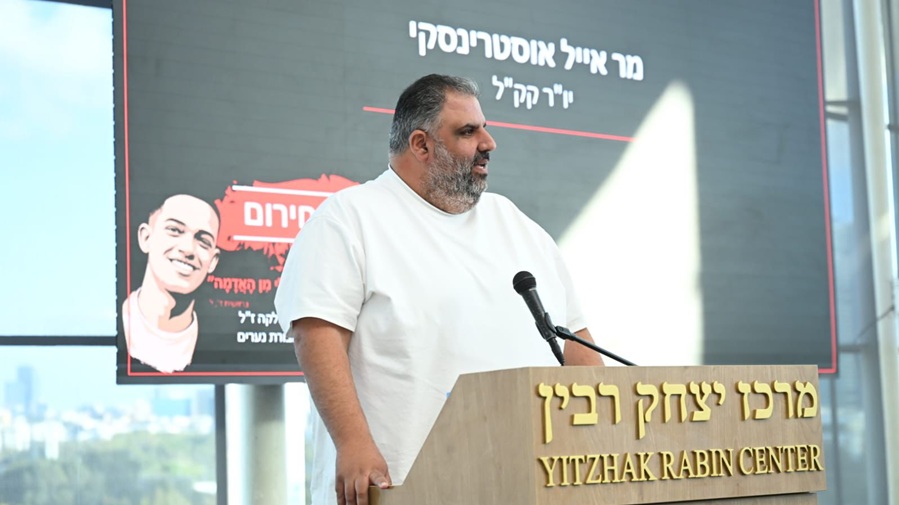
The evening opened with remarks by Amir Halevi, Chairman of the Public Council on the Joint Council of Mechinot. Additional speakers included Dalia Rabin, head of the Yitzhak Rabin Center; Eyal Ostrinsky, Chairman of KKL-JNF; and Sar-Shalom Gerby, Head of the KKL-JNF Education and Community Division.
At the heart of the conference was an open conversation between Rabbi Yoav Ende and Yarus Zelka, who shared her personal pain, the tools she received during her time at the academy that now help her in the legal struggle, and the responsibility resting on Israeli society to stop the wave of violence.
Yarus Zelka, sister of Yemanu Zelka Z”L and graduate of the Hannaton Mechina, said:“The tragedy that struck us could happen to anyone. I expect participants and graduates of the mechinot to increase the light — to become active partners in the fight against the terrible violence in our society. It is unimaginable to walk the streets feeling that we could be murdered at any moment. Come with us to the court hearings, cry out with us, wake up every morning motivated to create change. Engage in education, work with people, create hope.
“We are all responsible for ensuring that another murder does not happen here. As a society, we have become indifferent to violence. This was not the murder of an Ethiopian — it was the murder of an Israeli. We must not frame this murder as something belonging only to one community. Doing so excuses us and strengthens the inciting and violent discourse in Israeli society. The change must begin here.”
Avishai Berman, CEO of the Join Council of Mechinot, said:“Our decision to pause and gather shortly after Yemanu’s 30-day memorial is an attempt to make what happened there in Petah Tikva an event that belongs to all of us — a murder that feels as though it happened right beneath our own homes. A lesson, a moment for repair, for changing direction.
“That is also why, together with KKL-JNF, we decided that next year’s entrepreneurship competition in the academies will be dedicated to initiatives focused on reducing and eradicating violence in our society — turning these emotions and words into practical action.
“To the 400 young men and women sitting here today: you have the potential and ability to influence thousands, even tens of thousands. First through personal example, and then through the choice to intervene and not stand by as violence continues to rise. To behave differently, with respect, to change the toxic discourse on social media. To do good.”
Eyal Ostrinsky, Chairman of KKL-JNF, said:“The shocking murder of Yimenu Binyamin Zelka z”l is an extreme warning sign that demands an urgent wake-up call. We see the participants of the pre-military academies as the next leaders of Israeli society — those who must lead change and foster a unifying, respectful, and statesmanlike dialogue. In the face of public figures who fuel hatred and violence, the academies are raising a generation of leadership, responsibility, and social involvement — a generation rooted in solidarity and mutual respect. We at KKL-JNF will stand with the academies and provide the tools and resources needed to promote unity and eradicate violence.”
Dalia Rabin, Head of the Yitzhak Rabin Center, addressing the young participants, said:“My father’s message before he was assassinated was that violence erodes the foundations of democracy. We are here today in memory of a young man murdered by other young men who chose violence. We have lost the ability to contain those who are different from us — a society living on the edge. The reality demands joint action, and you represent responsibility, solidarity, and mobilization for the common good. The great diversity among the academies reflects a belief in social and ideological diversity united by a shared purpose. The academies are a field nurturing a future of many colors. We will be a home for you. You are the future.”
The Joint Council of Mechinot brings together dozens of pre-military academies across Israel, educating approximately 6,000 participants each year from all sectors of Israeli society. Alongside preparation for meaningful military service, the academies engage year-round in social action, volunteerism, and education for leadership, responsibility, and community involvement — all as part of the effort to cultivate a values-driven, connected, and engaged generation of Israeli leadership.